Tchula, Part 2
The Delta

Before moving to Mississippi, I pictured the Mississippi Delta as a place where some great river approaches the sea. Like the Nile Delta or the Mekong Delta.
I was wrong. It’s telling, in hindsight, how wrong I was about the basic physical parameters and descriptions of a region where geography is the central character in so many stories.
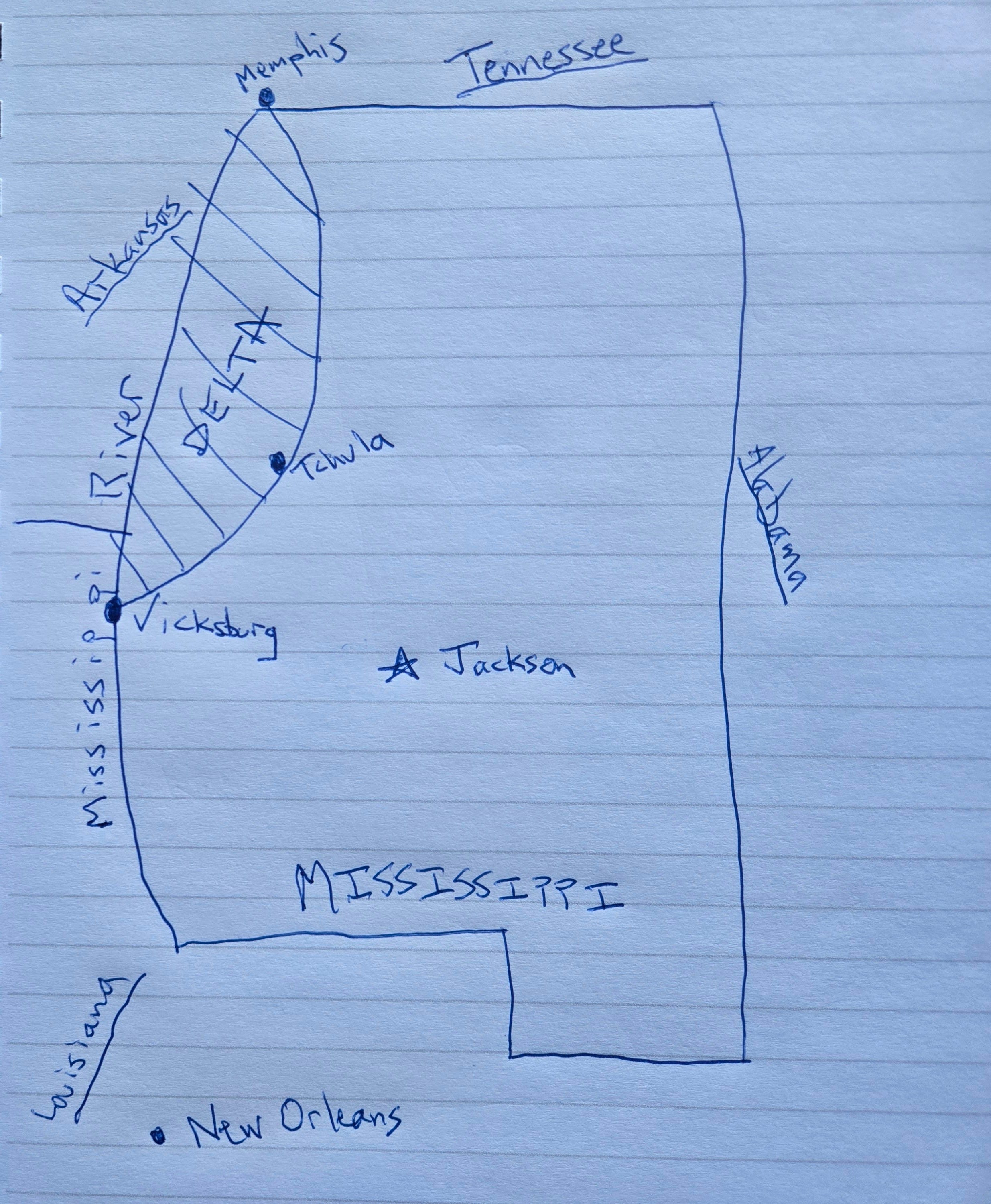
The Mississippi Delta is not a Delta like the Nile or the Mekong. For one thing, the geographic delta of the Mississippi lies past New Orleans, far south of Vicksburg, the town on the Mississippi River where the Delta ends. Nor does the Mississippi River divide and split as it passes along the western edge of the Delta. Instead, the Mississippi River broadens and deepens, gaining volume as it takes in the numerous smaller rivers that flow through the Delta.
There’s the Yazoo River, which passes through towns like Belzoni, where I lived. The confluence of the Yazoo and the Mississippi, at Vicksburg, forms the end of the Delta.
There’s also the Tallahatchie River, famous for the bridge from which Bobbie Joe McAllister jumped in the Bobbie Gentry song, and infamous as the river where Emmett Till’s corpse was submerged, chained to a cotton gin fan.
These minor rivers, and many others, when not dammed and controlled by levees, will flood, as will the Mississippi. Before the Delta began being cleared for cultivation in the early 19th century, flooding left behind sediment many feet deep that’s ideal for growing crops, such as cotton.


On the Mississippi side, east of the river, the flooding, and the sediment it left, was confined to the plain of the Delta because of the high, hard bluff that forms the Delta’s eastern edge. This bluff follows an arc, mostly north-south, from Memphis to Vicksburg. Because of this bluff, when flooding occurs, it remains on the plain, like water in a backyard wading pool is kept in by the side of the pool.
No flood has inundated the entire Delta since 1927. The region is now governed by flood control measures including levees, ditches, and dikes, that are so common that they seem almost naturally occurring. However, it’s impossible to live in the Delta and forget how easily the water could return. The Delta doesn’t feel like dry ground; it feels like a place that’s in between floods.


The students I taught grew up with the floods and understood the geography better than me. Most of them lived in trailers on low ground, between train tracks and bayous. They referred to the bluff, rather pronounced above Tchula, as “up the hill.” The flood plain of the Delta, including the town of Tchula, was “down the hill.”


The school was up the hill. Thus, when I say that I taught in Tchula, Mississippi, I mean that I taught at the school that children from Tchula attended at that time, along with children from other small towns nearby.
White settlement of Tchula began in the 1830s, after the removal of the Choctaw. Many early white settlers were planters who owned slaves. Slavery was abolished in the 1860s. Nevertheless, as was common across the region, by the turn of the 20th century, the predominant economic activity had reverted to the plantation system, with white planters owning the land and controlling local affairs, and large numbers of disenfranchised, intentionally uneducated African Americans providing labor.
I learned some of this history, broadly, in my first weeks of training, before I started teaching.
I learned more history one morning, in a more pointedly local way, as all students were being indefinitely detained yet again in the gymnasium upon their arrival at school.
My teaching schedule included Algebra 1 for 1st, 2nd, 3rd, and 7th periods. I chafed at missing 1st period, and at least part of 2nd period, too, for students to be in the gym. I couldn’t skip one or two classes, then teach new material to later classes. I needed all students in my classroom. Or the day would be lost.
As I stood in the hallway, annoyed, the guidance counselor walked by. Unlike the principal and vice principal, the guidance counselor was from the local community. She’d been at the school for many years. She was pragmatic, detached, perhaps cynical. She also basically ran the school. I decided to say something. “I don’t understand why we’re missing more class,” I said. “That’s the last thing these kids need, to be in the gym with their friends and miss even more class.”
“Mr. Nastrom, let me tell you something. I’m doing this for a very good reason. These kids—they’re not going to learn right now, no matter what. There was a riot last night down in Tchula.”
“Those seem to happen a lot.”
“Well, I’m trying to keep that foolishness they see down the hill from coming up here. I don’t want someone getting shot at school.”
“Of course not,” I said.
“You’re not from here, so you wouldn’t understand. But this is all still left over from the plantations. Yes, the plantations. These families were on different plantations, way back when, and they fought each other then, and they’re still fighting now. These kids—you think they go home and do their homework and go to sleep? They’re out in the streets, doing whatever they want. Most of them were at the riot last night.”
“That explains things,” I said. “It makes sense.”
“I don’t know if it makes sense or not, Mr. Nastrom,” she said, “but I’m holding them in that gym until they’ve settled down.”
My first few weeks in Mississippi, driving around the Delta, I found it breathtaking and stunning. But once I began actually teaching, and the history of Tchula came to me each day with my students, I heard the curses and saw the ghosts mixed in with the beauty. Before long, I fully accepted that the haunting had seeped into me, just as I knew the land wasn’t really land, but a flood plain awaiting a flood.

